I am now blogging at https://freevangelic.com. Would love to see you there and hear from you.

Lucille Ball, resting
My home is filled with the scents of roast and chocolate cake. The quilt upon which I lie and write – a double-wedding ring from Mom the Christmas before my wedding – is finally growing soft with age. Her quilts are so stiff when we first get them, filled with tiny stitches that won’t lie down. I can almost stand the quilt up on its folded end. As it gets used, though, the threads of the fabric and those stitching it together into a beautiful pattern learn where to bend. Sometimes one may even break here and there. As it’s tossed in and out of the washing machine and dryer, as kiddos and pets wallow all over it, as it gets crumpled each night and then smoothed again each morning, the threads within keep bending and stretching.
Eventually, they settle into a rest of being.
The quilt becomes a source of warmth, comfort, and pleasure where before it was only a thing of beauty, a representation of effort and talent. It is still all those things years later – the beauty of this quilt struck me when I cast it across the bed two nights ago – but it is all those other descriptors now, too.
I’m like this quilt. I was stiff, put together, and an outwardly beautiful example of my parents’ love…but now I’m more. Now I’ve bent. I’ve been broken. Tossed around in the tumbler of life. Now I’ve softened enough to be a source of comfort, warmth, and enjoyment in ways I could not before the bending and the breaking.
Now I settle into a rest of being.
As of August 14, 2018, 7:59pm EST, I resigned from SON Studios.
This will come as a shock to some and I am sorry I have not called each one of you before posting this notice. Frankly, I’m not sure my heart or my introverted brain can last through calls with all of you whom I love and care so deeply about, you who have been so encouraging to me and to SON. Thank you. A million times, thank you. The richness of your relationships has made this six-year attempt at a non-profit worth everything.
Naples, for all its cosmopolitan flair, is still a small community. I accept that there will be “talk.” The short story is that several folks had unexpected events in their lives that cost SON about $1mm in pledges and promised funds over the past year. SON simply ran out of runway to afford operations and I could no longer afford to work without pay.
Much must be navigated and decided. The Board agreed for all of the projects and clients to leave with me. It’s been a humbling and encouraging experience to call each person and hear them say they’ll stick with me for whatever’s next. I’m not sure what will happen as this page turns, but I do know this:
The mission of SON – to use media for good – is the heartbeat of who I am. It may require a different approach (what was it Thomas Edison said about failing 10,000 times on his way to finding the right method?), but that’s okay. I’ve never minded a challenge.
For now, I just needed to acknowledge publicly that I’m no longer at SON. It felt deceptive to not say something. You are welcome to email me at rebeca@seitzwritesllc.com or, if you have my cell number, to use it.
For SON business, please reach out to the remaining Board members (on the SON website).
If you’ve been a member or donor to SON, if you’ve attended an event or taken the time to mail in cards of encouragement, leave voicemails of support, or shoot over emails with cheers – thank you. I sit here today knowing that there are incredible people in this nation who fervently wish to harness the power of story toward a positive end. I love y’all for that. Thank you.
 I am the great, great, great, great, great, great granddaughter of Revolutionary War hero, Major General William Moultrie (the last man appointed by Congress to that rank).
Dear G6Grandfather,
We still talk of you. How you and your 400 men fought off 2,000 British soldiers to keep Sullivan’s Island from falling under their control. It’s a point of family pride that your victory in South Carolina encouraged and emboldened the men in Philadelphia who were penning the Declaration of Independence. You let them see that we could win our independence. We could fight and win. You did that.
I wonder if you know about the statue of you? It’s in White Point Garden in Charleston. Erected in June of 2007. You’re 8 feet tall and standing on a 7 foot pedestal. You’re hard to miss!
Yes, we remember you aloud.
You enslaved people, G6Grandfather. How could you?
And don’t even start with all the excuses. Did you know we’re still saying them today? We are! We talk about how it was the culture then, and the necessary thing for the economy. We tell people that slavery wasn’t just a Southern thing and we spew out millions of words, thousands of deflections – many true – even while we cringe inside. I hate this part of being a Southern woman.
You know what I’ve wondered?
I’ve often thought about your time before you were Major General William Moultrie of Washington’s great Continental Army. You know what I’m talking about. Yes. That time. That year before your heroic defense of Sullivan’s Island – I’m talking about the raid you led as colonel of the 2nd South Carolina Regiment.
Are you ashamed of that now?
No, that’s not what I want to ask you.
What I really want to ask is harder. It’s harder because as soon as I ask it, I answer for you with the words I desperately want to be true – an answer that could be true. It could.
You know, every man on both sides of the family in the last generation served in a branch of this nation’s military. You’d be proud. The family dedication to the nation has stayed strong. We don’t talk much about the fighting they’ve done, either.
But I wish I could talk with you about yours. Were you killing enemies to the nation’s independence…or runaway slaves? What were they in your mind?
A year later, you killed British soldiers. White men, most likely. In doing so, you won a decisive victory that helped lead to American independence. Was your intent then the same as the day you killed the slaves?
Oh, Grandfather.
We’re taking down statues of men like you now. A white woman was killed by a white man who thought he was somehow “better” just because he’s white. Others of many ethnicities were seriously injured.
Do you fold in upon yourself, broken by the idea that this thought even exists? That you helped perpetuate it? How did you live in the dissonance of fighting for liberty while removing it from black men? How?
Oh, I want to scream at you! Why couldn’t you and those other men – good God, you were smart enough to start a nation! You thumbed your nose at a monarchy! – how could you not figure out a way to end slavery, too?! You all said how awful it was. You said it was an offense to God. You said it was breaking with natural law. And yet you were so scared to break the economy – so worried that it would cripple the nation and we’d lose our independence – that you let slavery continue.
You kicked that evil ball down the field for another generation to handle.
Don’t we say in our family to do good and let God handle the result? Couldn’t you trust that?
For Mother’s Day this year, my sweet Hubs surprised me with something I’d long wanted: a kit from 23andme. (It’s a DNA test that reveals your ancestry. Yeah, you’re not going to understand “DNA” either.)
Anyway, scattered within the expected British, Irish, French, Scandinavian and “Broadly Northwestern European” lay two surprises: 0.2% Native American (apologies, Aunt Ruth, you were right)…
…and there…
…the eyebrow-raiser…
…just a tiny little 0.1%…
Sub-Saharan African – West Africa.
Yep. I’m not all “white” (what does that even mean?). And, since I don’t know when or how that little 0.1% came to be, you may not have been either.
I love this part of me.
Would you have?
What would you say about the idea of taking down your statue? (Let’s assume you’re humble enough to not have wanted it in the first place. Work with me here, G6.)
If you knew that your statue makes citizens fold in on themselves, broken and hurt by the reminder that their family worked your land for your gain…what would you say?
I’m one of a lot of your granddaughters. Am I supposed to say something? Would you want me to?
You know, the best part of our family came from your line. Retta Moultrie. I’m named after her mama, Rebecca Hayes (your great granddaughter). Aunt Retta. Born in 1894. Oh my heavens, a better woman has never walked this earth. She helped raise me. Lived to be 102! I can still feel her little, wrinkled hand on top of mine as we sat on her velour couch, singing hymns together. I can hear her humming as I played with her white hair. I have three pillows on my bed that she sewed by hand. They’ve lost the smell of her but, every great long while, I can close my eyes and nearly catch the scent by memory.
She taught me to love people, G6Grandfather. All people. To be kind. Patient. Generous even when I didn’t have plenty. Lord knows she didn’t. If you were anything like Aunt Retta, you’d care deeply about the hurt that comes from the racial divide of today. A divide you helped cause.
I hope you’d also be relieved to see that slavery has been eradicated. We’ve found a way to be economically strong without it. We are a fully free nation. No monarchy. No ruler. The government by, of, and for the people that you and others created is still going.
The descendants of your slaves? They’re no doubt leaders today! Business owners. Doctors. Elected officials. Engineers. Scientists. Writers. Do you see how powerful freedom is? Look where we are! The last governor of South Carolina – the very state where you were governor for two terms – was a woman – an Indian woman! And now she’s the Ambassador to the United Nations!
Oh, G6Grandfather, we’ve come so far.
Thank you for fighting to create an independent nation. A nation conceived in liberty, still struggling to fully live in it.
Maybe your statue isn’t just a reminder of your Sullivan’s Island victory on behalf of the United States and its fight for independence.
It is also a reminder of that year before.
I need to remember you were both a hero and a horror.
As more and more writers, filmmakers, managers, publishers, movie lovers, book lovers, and tv fans join the movement at SON, I have an awesome opportunity to see the common ground on which we stand regardless of religion (or lack thereof). It’s so cool! It also raises questions I haven’t focused on for a while. What makes an atheist choose the moral high ground? What spurs a Jewish woman to work with a roomful of Jesus lovers? How did the God Christians worship today come to the world’s collective awareness in the first place? What motivates all of us to make the world a better place?
When I was 16, my dad took me aside and asked why I subscribed to the Christian faith. I don’t remember my answer, but it was probably the textbook Southern Baptist one as that is the only denomination or way of belief I knew at that point. Daddy and Mom raised all of us kids in Baptist churches. Whatever I said that day, I remember Daddy shaking his head at me. “Your faith isn’t yours if it’s part mine or your mom’s. You need to figure out what you believe and why you believe it.” He set me off on a course of reading about the world’s religions.
The questions I explored then arise again as SON expands. Why am I here? Why do storytellers exist? Why does almost every human respond to a story? Did someone put us here? Is there a higher being in charge? Can I interact with that being? How did that being come into being? How is existence supposed to work? Does it work that way? Can we make it work that way? What is the story behind all that has been, is, and will be? Is there a story?
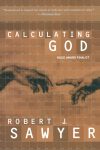
These kinds of questions and more are masterfully woven into an incredible novel I finished this past weekend: Calculating God by Robert J. Sawyer. While there are a few places in which the arguments for answers overtake the storyline, I remained fascinated throughout. The story premise is that an alien (Hollus) comes to Earth with the news that Hollus’s planet, another planet with live beings, and Earth have all experienced five cataclysmic events that altered the evolution of life on that planet. Hollus says this is proof that there is a God and that God is manipulating the formation and evolution of life. The big question is: why? Hollus studies life’s history on this planet while holding provocative conversations with the Canadian paleontologist helping him research.
If that were all this book was, it would be well-worth the read.
But the ending of this story is…well…it’s…astounding.
If you’ve ever wondered how God could have come into being…
If you’ve ever thought that maybe there is a being in charge, but it might not be the God of your knowledge base…
If you’ve ever wondered why horrors like cancer could possibly be allowed to exist…
Heck, if you’re just tired of figuring out the ending of a book when you’re barely halfway through it…
You’ve got to get this novel.

James D. Seitz
Three years ago, the Hubs and I moved the kiddos down to Naples to help out with Jim’s care. He and Grace allowed us the honor of being a real part of this journey and, while I won’t lie and say it was anywhere in the same ballpark as easy, I’m glad we did. I’m happy we got that time with him, that my kiddos know the amazing grandfather they had, that my mother-in-love and I grew closer as we cared for the love of her life, the man she was married to for 55 years.
Now, most of my Facebook friends are actual friends. They’re people I went to school with, have worked or volunteered with. A few are readers of my novels and I have the gift of their feedback and input as I write additional stories. The folks I call “Facebook Friend” are mostly real relationships. So, rather than call a lot of people and repeat our news, I posted on Facebook that Jim had passed.
I’ve done this exact same thing to friends who lose people to death. I’ve done it a lot, even from the moment we were told Jim needed to go into hospice care. Emotion overwhelmed my mother-in-love and husband, so I’m the one who tried to give Jim the news. He read it on my face before I could speak and said, “I’m going to heaven aren’t I?”
I responded, “Yessir, and I’m a little jealous.”
So, yes, I get the instinct to focus on the positive (heaven!) and brush right past the hideous (death). But, I want to go on record as saying I really don’t like it.
I’m a processor. I need time to process, reflect, think, ponder, be quiet and still before I feel as if I can move past a significant emotion. Right now, I hurt. A lot. I’m sad. I miss Jim – even the one who couldn’t speak because Parkinson’s stole his voice. I miss how he always, always smiled when I came into the room. I miss having someone in my life who wanted to hear every single, solitary detail of every single business trip or event I participated in. I miss the one who enjoyed listening to who came with whom and who wore what to this film premiere or that gala. I miss the man who knew the backstories of so many influencers in this town – how they became the people they are today. I want to hear his stories again of chairing balls and functions and how to navigate Board member and funder relationships. I want to ask him a question and see him turn his head, look off in the distance, and give my inquiry real thought before responding with some piece of wisdom I couldn’t have found otherwise. I’ve missed all this for a long time because Parkinson’s took it away but I couldn’t mourn it because we all had to focus on the care required by that moment, that hour. Now that he’s gone all of what was taken by this disease hits at once and I miss him.
I miss him.
I don’t care right now about heaven. I really don’t. I care that right now, today, I can’t go up to his bed, kiss the top of his head, and say, “Hello, blue eyes. I love you.” I care that my mother-in-love, a woman who has been an incredible mother to me for twelve years, is alone for the first time in her 77 years of life and isn’t sure how to navigate the silence other than turning on the radio and leaving it on all day. I care that my husband isn’t sure what to do with himself now that he doesn’t have to go and lift his daddy from the wheelchair and place him into bed every early evening or run over there when Jim needed taken care of some other way. I hurt that my youngest doesn’t have much memory of her grandfather as anything other than a Parkinson’s patient and I hurt more that my eldest does and misses the grandfather he knew before this hideous disease invaded our lives.
I don’t care about heaven right now, y’all. Trying to skip over the pain doesn’t lessen it. It forces me into a place of smiling and nodding, pretending that yes, sure, I’m all good, because, hey, we’ll see him again and isn’t that grand.
It’s not grand today. Please let it be okay that it’s not grand. Just for a little bit. We can rejoice in stuff worthy of rejoicing about in time. For now, I need to take a friend’s very wise advice and be gentle with myself. I need to let myself recognize that even though this was a long, long battle that I thought gave me time to be prepared, I was wrong. It still hurts. Each day is a little better than yesterday – I laughed a real laugh yesterday morning with the kiddos, went to the office, and even managed to keep a lunch date with ladies from my neighborhood – but it still hurts. And I’m going to let it hurt for a little while longer. It should hurt. A truly wonderful man is not here anymore. It should hurt.
I try to think of what I will say to people in the future when I hear that death has taken someone they loved off this earth. I don’t think I’ll jump to references of heaven. I think I’ll say, “I’m sad that you’re sad,” or “I’m so sorry this pain has come,” or borrow from my wise friend Mary and say, “Be gentle with yourself.”
Anyway, I do appreciate all of you who have offered comfort and even those of you who have jumped to the heaven references. I know you mean well. I know that. I love you for that. I just wanted to ask you to let me sit here in this remembrance of him and missing him for a little while longer before I have to take a deep breath, set it aside, and pick up full time living and hoping again.

Photo credit: HillaryClinton.com
The entire nation will be forced to pay attention to word choice again. Remember the hours that were given to debating the meaning of the word “is” when the Clinton/Lewinsky stuff went down? It’s already starting with Hilary. Every time she has referred to herself as the “first female presidential nominee” she has been careful to include the phrase “from a major party” as well. That makes it true. Those who ignore the tacked on phrase raise all kinds of hullabaloo on social media about how this is yet another lie from Hillary. But, well, it isn’t – not the way she said it.
And this is how it’s going to be for four more years. She’s going to say something. Everyone will lose their minds talking about how it isn’t true. Everyone else will scream back the exact words she said and how they are, indeed, true. And no one will come any closer to speaking about and working on things that matter.
Four years.
Discussing word choice.
Parsing terms.
I’m a word lover, which makes the coming reality a not entirely bad scenario. I’m thrilled we will pay attention to our language and (hopefully) say what we mean or (at the very least) realize that SHE said exactly what she meant.
But I’m sad that we’re going to lose sight (if we ever had it) of poverty, income disparity, racial tensions, sexual harassment in the workplace, terrorism, human trafficking, hunger, and other serious issues rampant in our nation. That will be the loss of the Clinton presidency: ability to have a truly national conversation regarding situations that matter.
And that leaves me sad because one thing women in the workplace are known for is an ability to get everybody to the table, talking, working together despite differences.

With the release of my latest novella, SECOND GLANCE, some folks have noticed that I don’t tend to let my characters go too far (if at all) past kissing. Then they read my blog (especially that Morning Sex post) and decide I must be a prude. While that makes me laugh hysterically (and my husband gets a GIANT kick out of it), I’ve decided to reveal the reason behind my choice and explain here why kissing is such a big deal to me (and, by extension, my characters).
I am a sex abuse survivor. Doesn’t make me special – at least a quarter of the women in this country can (sadly) say the same thing. My husband and I were married for seven years before I voluntarily, spontaneously initiated a kiss between us.
Our son was five, our daughter nearly two. Over a year earlier, I’d seen our precious littles playing in the living room floor and been surprised by the thought, “They’re depending on me to teach them how to live. They need me to be healthy.” I knew I wasn’t healthy, mentally and spiritually, regarding physical love but I’d gotten by and had no intention of upsetting the applecart until that breathless moment when I understood that these little beings didn’t need to be affected by my past.
They were free of it.
And I wondered if I could be, too.
So, I embarked on a journey to deal with “the shit” as my husband and I came to call it. I apologize for the vulgarity. If ever there is a time to use a vulgar word as a descriptor, my past experience seemed to be it.
Fast forward nearly two excruciating/exhilarating years later, and I found myself walking through our breakfast room right through the space in which I’d stood contemplating my children’s need for a healthy mom. As I glanced across the room and into the kitchen at my husband, a strange feeling overwhelmed me. I couldn’t puzzle it out at first. I knew part of it to be love. I was feeling love for that man. But it took me several seconds to realize I had a God’s honest desire to kiss him because I loved him. I’d never had that!
I’d been standing there staring at him as I puzzled this out, which drew his attention. He turned his face toward me. “What?” he asked.
I walked over to him, tilted my face up to his, stood on my tiptoes, and kissed him. I’ll hold to decorum and just say here that we’ve been married nearly 12 years and we both remember that kiss.
Kissing is the most emotionally intimate of all physical acts. It is the hardest to ignore when it’s happening (trust me, I know) – much harder to divorce your brain from than sex. A kiss allows another human being into the space of your life from which you speak – and speaking is how everything came to be in the first place. Your mouth is both powerful and vulnerable, giving and receiving, all at the same time. A kiss says a million feelings and thoughts without uttering a spoken word.
I’ve kissed wrong. I’ve kissed right.
Done as it was intended by the Creator, kissing is powerful. It is definitely powerful enough for my characters to convey the depth of emotion and story needed to sweep a reader off her feet.
You know what I don’t find powerful? When two characters who met five milliseconds ago kiss for the first time and somehow that’s an immediate assumption that sex is wanted/needed/necessary/wise. With all the sex on tv and in films and books, I think the shock factor for writers today lies in revealing a kiss for what it genuinely was meant to be, and is.
Having worked very hard and finally come into the experiential knowledge of the power of kissing. I wish we writers could start giving the act its proper due.
So, I do.


 Rebeca Seitz's Blog